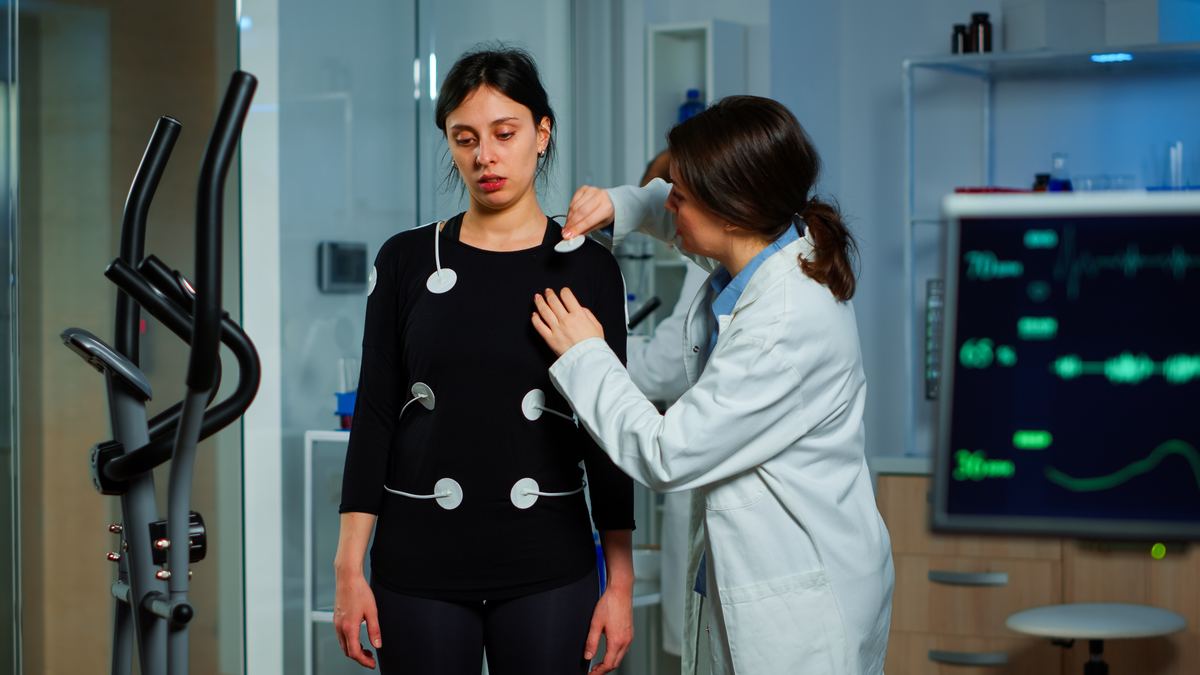
Metabolism is measured by tracking the oxygen your body uses and the carbon dioxide it produces, a method called indirect calorimetry. Outside a lab, formulas and fitness trackers give estimates, and their accuracy varies a lot.
Key takeaways
- Indirect calorimetry is the standard test for resting metabolic rate. It takes 15 to 30 minutes of quiet breathing.
- Doubly labeled water measures total energy use over one to two weeks of normal life. It is used mainly in research.
- Formulas such as Mifflin-St Jeor estimate the average for your size. Your own rate can sit well above or below the estimate.
- In one validation study, the most accurate wrist device was off by 27 percent on energy expenditure.
Why oxygen tells you calories
Your cells release energy from food by combining it with oxygen, producing carbon dioxide and water. The amount of oxygen consumed is proportional to the energy released: roughly 5 kcal per liter of oxygen. Measure the gases, and you can calculate the energy.
What is indirect calorimetry?
Indirect calorimetry is a breath test that measures your resting metabolic rate. You lie or sit still and breathe through a mouthpiece, a mask or under a clear hood. A machine called a metabolic cart analyzes the air you breathe out.
How to prepare
- Do not eat for at least 4 to 5 hours, and often overnight.
- Avoid caffeine, nicotine and exercise beforehand, as the clinic instructs.
- Rest quietly for 10 to 20 minutes before the measurement starts.
What you get
Your resting metabolic rate in kcal per day, and the respiratory quotient, a ratio that shows whether you were burning mostly fat or mostly carbohydrate. Hospitals use the test to set nutrition for patients. Some clinics, universities and gyms offer it to the public.
Doubly labeled water
You drink water in which the hydrogen and oxygen are tagged with harmless, non-radioactive isotopes. Over one to two weeks, urine samples show how fast each isotope leaves the body. The difference reveals carbon dioxide production, and from that, total energy expenditure in everyday life.
This is the method behind the largest study of metabolism across the lifespan, which covered 6,421 people. It is accurate and expensive, so you will rarely find it outside research.
Metabolic chambers
A metabolic chamber is a small sealed room where a volunteer lives for 24 hours or more while the air is analyzed. It captures sleep, meals and activity precisely. They are found only in a small number of research centers.
Prediction formulas
The Mifflin-St Jeor equation estimates resting metabolic rate from weight, height, age and sex. It was developed from measurements of 498 adults. A systematic review for the American Dietetic Association found it estimated resting metabolic rate within 10 percent of the measured value more often than other common formulas.
A formula describes the average person with your measurements. In a study of 150 adults, about a quarter of the variation in basal metabolic rate was not explained by body composition, age or sex.
Fitness trackers and smartwatches
Wearables estimate energy use from heart rate, movement and your profile. In a 2017 study, researchers at Stanford tested seven wrist devices then on the market on 60 volunteers during walking, running and cycling, against laboratory equipment. Six of the seven measured heart rate with a median error under 5 percent during cycling. None measured energy expenditure with an error below 20 percent: the most accurate device had a median error of 27 percent, and the least accurate 93 percent.
Trackers are useful for trends, such as steps and active minutes compared with your own previous weeks. Treat the calorie number as a rough guide.
Comparing the methods
| Method | Measures | Accuracy | Availability |
|---|---|---|---|
| Indirect calorimetry | Resting metabolic rate | High | Clinics, some gyms |
| Doubly labeled water | Total daily expenditure | High | Research |
| Metabolic chamber | 24-hour expenditure | Very high | Research |
| Formula | Estimated resting rate | Moderate | Free |
| Wearable | Estimated daily expenditure | Low to moderate | Consumer devices |
Where can you get your metabolism tested?
Indirect calorimetry is offered by some hospitals, university exercise labs, sports-medicine clinics and gyms. Ask for a resting metabolic rate test and how you should prepare.
Do you need a test?
Usually not. For most people, a formula plus two to four weeks of tracking body weight gives a workable estimate of total daily energy expenditure. A measured value can help if formulas seem far off for you, or when a doctor or dietitian is planning treatment.
Frequently asked questions
Can a blood test measure my metabolism?
No. Blood tests can check things that affect metabolism, such as thyroid hormones and blood sugar, but they do not measure metabolic rate.
Are “metabolic age” readings meaningful?
They compare your estimated resting rate with averages for age groups. The estimate comes from a formula, so the result is approximate.
How often does metabolic rate change?
It shifts with body weight, muscle mass, illness and age. Day-to-day changes in resting rate are small.
Sources
- Pontzer H, et al. Daily energy expenditure through the human life course. Science. 2021.
- Mifflin MD, et al. A new predictive equation for resting energy expenditure in healthy individuals. Am J Clin Nutr. 1990.
- Frankenfield D, et al. Comparison of predictive equations for resting metabolic rate in healthy nonobese and obese adults: a systematic review. J Am Diet Assoc. 2005.
- Johnstone AM, et al. Factors influencing variation in basal metabolic rate include fat-free mass, fat mass, age, and circulating thyroxine but not sex, circulating leptin, or triiodothyronine. Am J Clin Nutr. 2005.
- Shcherbina A, et al. Accuracy in wrist-worn, sensor-based measurements of heart rate and energy expenditure in a diverse cohort. J Pers Med. 2017.
Featured photo: DC Studio / Freepik