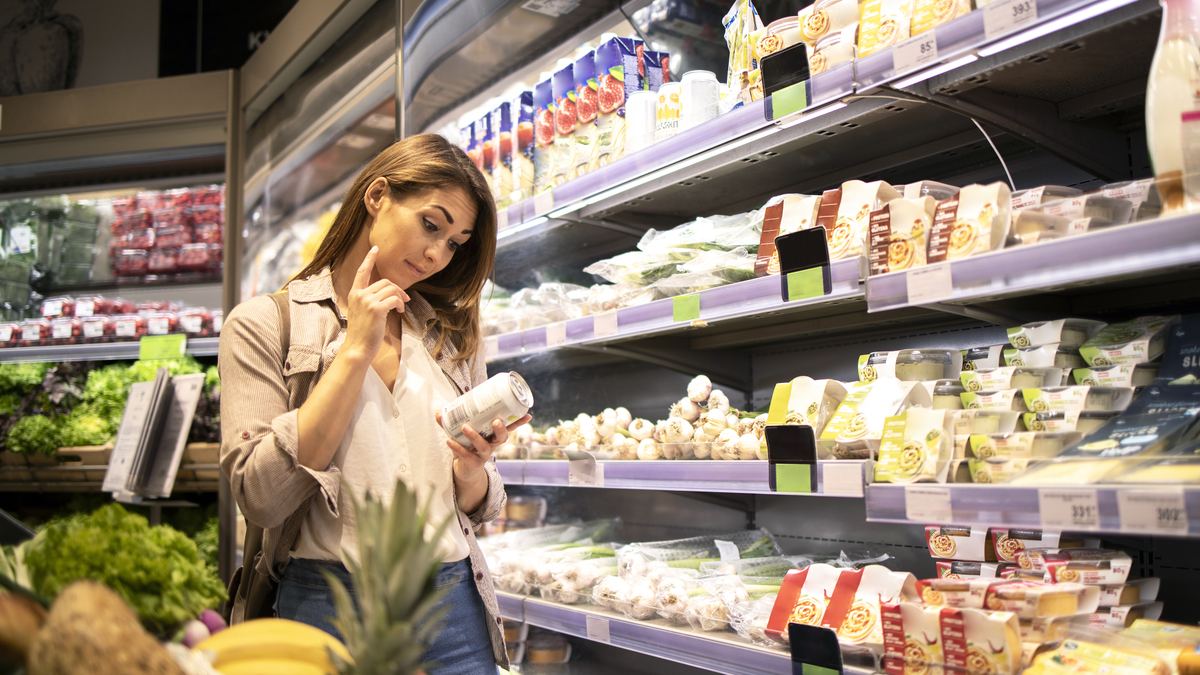
Reading a nutrition label takes under a minute: check the serving size, then the calories, then use the percent Daily Value to judge added sugars, sodium, saturated fat, fiber and protein.
Key takeaways
- All the numbers on the label refer to one serving, which may be smaller than what you eat.
- 5 percent Daily Value or less is low; 20 percent or more is high.
- Added sugars have their own line, with a Daily Value of 50 g. The 2025–2030 Dietary Guidelines go further: they recommend no added sugar and no more than 10 g in any one meal.
- The ingredient list is ordered by weight, heaviest first.
Step 1: Check the serving size
Start at the top. The serving size is shown in familiar units, such as cups or pieces, followed by grams. Everything below it refers to that amount. If the package holds 2.5 servings and you eat the whole thing, multiply every number by 2.5. Some packages that are usually eaten in one sitting now show the whole package as one serving, or give two columns: per serving and per package.
Step 2: Look at the calories
Calories show how much energy one serving provides. As a general reference, the label is based on a 2,000-calorie daily diet, but your needs may be higher or lower. See total daily energy expenditure.
Step 3: Use the % Daily Value
The percent Daily Value (%DV) shows how much a serving contributes to a full day’s recommended amount. The FDA’s quick guide:
- 5% DV or less of a nutrient per serving is low.
- 20% DV or more is high.
Aim for low %DV for saturated fat, sodium and added sugars, and higher %DV for fiber, vitamin D, calcium, iron and potassium.
Step 4: Check the nutrients that matter most
| Nutrient | Daily Value | What to look for |
|---|---|---|
| Added sugars | 50 g | As low as possible. See sugar and metabolism |
| Sodium | 2,300 mg | Lower is better for blood pressure. See blood pressure |
| Saturated fat | 20 g | Lower is better for LDL cholesterol |
| Dietary fiber | 28 g | Higher is better. See fiber and metabolism |
| Protein | 50 g (DV often not listed) | Useful for fullness. See protein and metabolism |
“Total Sugars” includes natural sugars from milk and fruit. “Includes Added Sugars” shows the part added during processing, which is the one to limit.
Step 5: Read the ingredient list
Ingredients are listed by weight, from most to least. A few clues:
- If sugar in any form is among the first three ingredients, the product is likely high in sugar; confirm it on the Added Sugars line. Sugar goes by many names: cane sugar, syrup, dextrose, maltose, fruit juice concentrate, honey.
- “Whole wheat” or “whole oats” as the first ingredient signals a whole-grain product. “Wheat flour” alone means refined flour.
- A long list of ingredients you would not use at home often signals an ultra-processed food. See ultra-processed foods and metabolism.
Comparing two products
Labels are most useful for comparison. Two breakfast cereals or two pasta sauces can differ several-fold in added sugar, sodium and fiber. Compare per serving, or per 100 g if serving sizes differ.
Claims on the front of the package
- “Low fat” products may contain more sugar.
- “Made with whole grains” can mean only a small amount; check the ingredient list.
- “Natural” has no strict definition for most foods.
- “No added sugar” foods can still be high in natural sugar, such as juice.
- “Boosts metabolism” is a marketing phrase, not a regulated health claim. See do metabolism supplements work?
A 30-second routine
- Serving size: how many am I eating?
- Calories per serving.
- Added sugars and sodium: low?
- Fiber and protein: decent?
- First three ingredients: whole foods?
Frequently asked questions
What does % Daily Value mean?
It shows how much of a full day’s recommended amount of a nutrient one serving provides, based on a 2,000-calorie diet.
Are labels accurate?
The FDA allows some variation between the label and the actual content, so treat numbers as close estimates.
Do fresh fruits and vegetables have labels?
Not usually. They are among the foods least likely to need one.
What does “0 g trans fat” mean?
A product can list 0 g if it contains less than 0.5 g per serving. Check for “partially hydrogenated oil” in the ingredients.
Sources
- FDA. How to Understand and Use the Nutrition Facts Label.
- FDA. Daily Value on the Nutrition and Supplement Facts Labels.
- U.S. Department of Agriculture and U.S. Department of Health and Human Services. Dietary Guidelines for Americans, 2025–2030.
Featured photo: aleksandarlittlewolf / Freepik