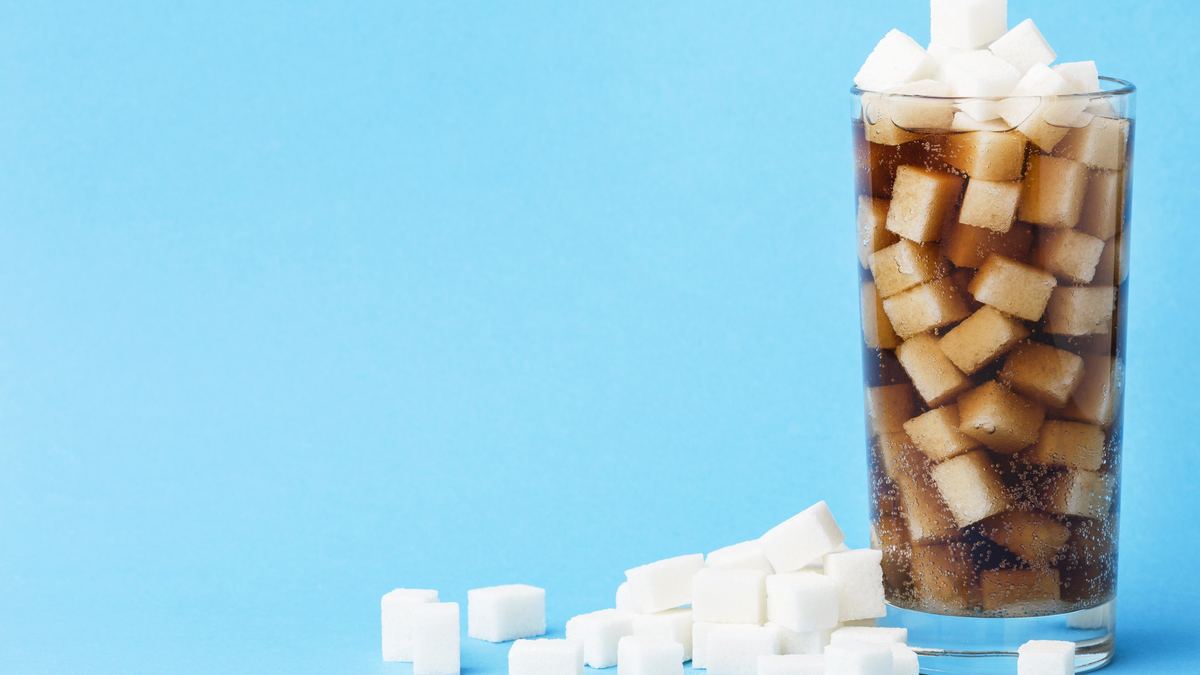
Added sugar does not break your metabolism, but it makes it easy to take in more calories than you burn, especially in drinks. Large reviews link sugary drinks with weight gain and a higher risk of type 2 diabetes. The World Health Organization recommends keeping free sugars below 10 percent of daily calories.
Key takeaways
- Sugar affects body weight mainly by changing total calorie intake.
- One to two sugary drinks a day was associated with a 26 percent higher risk of type 2 diabetes in a meta-analysis.
- The WHO advises under 10 percent of calories from free sugars, and suggests under 5 percent for extra benefit.
- Sugar in whole fruit comes with fiber and water and is not the concern.
Types of sugar
- Naturally occurring sugars are found in whole fruit, vegetables and plain milk.
- Added sugars are put into foods and drinks during processing or at the table: table sugar, high-fructose corn syrup, honey, syrups.
- Free sugars, the WHO’s term, are added sugars plus the sugars in honey, syrups and fruit juice.
How does your body process sugar?
Table sugar (sucrose) is half glucose and half fructose. Glucose enters the blood and raises insulin, and most tissues can use it. Fructose is processed mainly in the liver. In large amounts, particularly from drinks, the liver converts part of it to fat. This is one way that a high intake of sugary drinks contributes to fatty liver and raised triglycerides.
What the evidence shows
Sugar and body weight
A systematic review and meta-analysis in the BMJ, done for the World Health Organization, combined 30 trials and 38 cohort studies. Adults who reduced their sugar intake lost an average of 0.8 kg, and those who increased it gained about 0.75 kg. When sugar was swapped for other carbohydrates with the same calories, body weight did not change. The effect of sugar on weight ran through calories.
Sugary drinks and diabetes
A meta-analysis of 11 cohort studies with more than 300,000 participants found that people in the highest intake group, usually one to two sugary drinks a day, had a 26 percent higher risk of type 2 diabetes and a 20 percent higher risk of metabolic syndrome than those who drank none or less than one a month. Cohort studies like these cannot prove that the drinks themselves caused the difference.
Why drinks are the main problem
Liquid calories do not make you full the way solid food does, so people do not eat less to make up for them. A 12 oz (355 ml) can of regular soda contains about 39 g of sugar, close to 10 teaspoons and about 150 kcal.
How much added sugar per day is too much?
Major health bodies set the line low: the WHO at under 10 percent of calories, and the newest U.S. guidelines at no recommended amount at all.
| Source | Recommendation | On a 2,000 kcal diet |
|---|---|---|
| World Health Organization | Free sugars under 10% of energy | Under 50 g (about 12 teaspoons) |
| World Health Organization, further benefit | Under 5% of energy | Under 25 g (about 6 teaspoons) |
| Dietary Guidelines for Americans, 2025–2030 | No amount of added sugar is recommended; keep any one meal to 10 g of added sugars or less | No daily allowance set |
| American Heart Association | No more than 100 kcal a day of added sugars for most women and 150 kcal for most men | About 25 g (6 teaspoons) for women, 36 g (9 teaspoons) for men |
Where added sugar hides
- Soft drinks, energy drinks, sweetened coffee and tea
- Fruit juice and smoothies
- Flavored yogurt
- Breakfast cereals and granola
- Sauces: ketchup, barbecue sauce, some pasta sauces
- Bread, crackers and protein bars
On U.S. labels, “Added Sugars” is listed in grams under “Total Sugars”. Most ingredients ending in “-ose”, such as dextrose, maltose and fructose, are sugars. Sucralose, a sweetener, and cellulose, a fiber, are exceptions. Syrups, fruit-juice concentrates and nectars are sugars too.
Is fruit a problem?
No. Whole fruit contains fiber and water, is filling, and is associated with better health in population studies. Juice is different: the fiber is gone and the sugar is absorbed fast.
What about sweeteners?
Low- and no-calorie sweeteners cut sugar and calories when they replace sugar. Even so, the WHO advised in 2023 against using them for weight control, because long-term studies show no lasting benefit for body fat. The 2025–2030 U.S. guidelines do not recommend them either. Water, sparkling water, and unsweetened tea or coffee remain the best default drinks.
How to cut back
- Change drinks first. This gives the largest reduction for the least effort.
- Buy plain versions of yogurt, oats and cereal, and add fruit yourself.
- Halve the sugar in coffee and tea, then halve it again after two weeks. Taste adapts.
- Keep dessert for after a meal, when you are already partly full.
- Compare labels. Similar products can differ several-fold in added sugar.
Frequently asked questions
Is honey or agave healthier than sugar?
They are still free sugars with similar calories. Use them for taste, in small amounts.
Does sugar cause diabetes?
Not by itself. Excess body fat and inactivity are the main causes of type 2 diabetes, and sugary drinks contribute to both weight gain and risk. See insulin resistance explained.
Is high-fructose corn syrup worse than table sugar?
The two have nearly the same mix of glucose and fructose and similar effects at equal amounts.
Sources
- Te Morenga L, et al. Dietary sugars and body weight: systematic review and meta-analyses of randomised controlled trials and cohort studies. BMJ. 2012.
- Malik VS, et al. Sugar-sweetened beverages and risk of metabolic syndrome and type 2 diabetes: a meta-analysis. Diabetes Care. 2010.
- World Health Organization. Guideline: Sugars Intake for Adults and Children.
- U.S. Department of Agriculture and U.S. Department of Health and Human Services. Dietary Guidelines for Americans, 2025–2030.
- World Health Organization. Use of non-sugar sweeteners: WHO guideline. 2023.
- Johnson RK, et al. Dietary sugars intake and cardiovascular health: a scientific statement from the American Heart Association. Circulation. 2009.
- CDC. Rethink Your Drink.
Featured photo: magnific / Freepik